the team
Discover the passionate individuals behind Medbeats, dedicated to enhancing mental health support for transfer students through the transformative power of music. Our team is committed to creating a supportive community that bridges the gap between music and mental wellness.
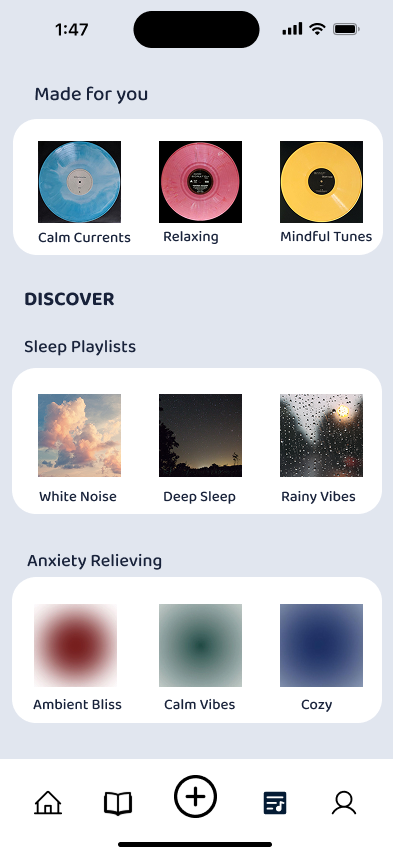
Medbeats is a journaling app that users can use to write about their thoughts and feelings. The user can also import their favorite song or artist in their entries. AI is then used to analyze what the user wrote and what song or artist they provided to create a custom playlist that is meant to address the concerns that they have to calm them down or relieve their stress while also playing music that they would enjoy themselves.
The target audience consists of college transfer students as it has been shown that they commonly deal with stress and anxiety when adjusting to their new schedule and environment. The app, unlike existing mental health apps, prioritizes the user’s choices and fully utilizes the healing powers of music. Students will feel empowered to have a safe space and, with the power of AI, enjoy personalized music therapy based on their preferences. This app can help serve students before and during their journey through college.
As lovers of music, we chose to start Medbeats because of our shared desire to improve mental health. Our initial target audience was all college students but we narrowed down our focus to transfer students. Our reason for this was because we believed that we could provide more personalized care by narrowing the project scope.
We began with a research stage that lasted several weeks, consisting of plenty of user interviews and surveys. Based upon our findings, out of 18 students, we created 10 key insights to guide the direction of the maturation of our app's core design.
However, 88.9% of students did not use mental health and well-being apps, and only two students used the mental health app known as “Finch.”In regards to student interest in MedBeats, eight respondents said yes to being interested, nine said maybe, and only one respondent said no, indicating an interest or slight interest in a journaling app like MedBeats.
12 respondents were likely to use the journaling feature to write their emotions or mood
72.2% of respondents preferred being given prompts when entering journal entries In regards to AI use, most respondents (66.6%) are moderately comfortable with AI-generated playlists, while a smaller percentage (16.7%) are uncomfortable.
When it comes to music preference, half of the respondents preferred full control over their selections with optional AI recommendations, 44.4% approve of a mix of AI use and personal choices, and only a few prefer fully AI-generated playlists. This suggests the acceptance of AI among our target audience but a strong preference for user autonomy as well.
55.5% of transfer students reported moderate difficulty in their transition, with 2 reporting a very stressful transition and 3 reporting a very easy transition.
72.2% of respondents struggled with socialization, indicating a struggle with isolation and difficulty incorporating themselves into the new environment. This is further reinforced when nine respondents find adapting to the new school system difficult.
Furthermore, 12 respondents struggled with mental health and stress, highlighting the emotional toll the transfer process is, and five reported having trouble with finding transfer resources.
A vast number of respondents reported feeling uncertain (83.3%), anxious (72.2%) and overwhelmed (61.1%) while navigating the transfer process, however, only three respondents reported feeling confident.
In terms of listening habits, 44.4% of students reported listening to music to relax, 22.2% to relieve stress, 16.7% to study/concentrate.
More importantly, 42.9% of students always listened to music to help manage stress and anxiety.
Week 3-4 Brainstorm:
Brainstorm ideas on what problem we are trying to address, research articles on the impacts of music on the brain and body, choose a specific population we will focus on and what kind of technology we are building
Week 5-6 UX Research:
Create questions for interviews and surveys in order to gather feedback from users, Conduct interviews and/or surveys on the population chosen, and analyze findings
Week 7-8 UX Design:
Begin on sketches, wireframes and mockups for the app we are designing based on research findings, finalize mockups and prototypes
Week 9-10 Coding:
Build our website to display our project and our findings throughout the quarter.
.png)